In A Short Sale, Who Represents The Lender?

Twin Cities February closed sales showed that bank owned foreclosures were 35% of the month’s closed units and short sales represented another 13% – making Lender-Mediated homes sales almost 50% of all residential home sales in the Minneapolis/St. Paul region.

On a bank-owned home the Seller is of course the bank and therefore the Listing Agent represents the bank.  On a short sale however, the Listing Agent represents the Seller, which in this case is the current homeowner.  So while the agent must treat all parties honestly, their loyalties and fiduciary duties are only to the Seller.

This situation leads to several issues:

Unfamiliarity with Lender’s Process
With the large number of lenders and servicers out there, a listing agent working on short sales may have had only a few experiences with the lender in the past (if any) and therefore may not be fully educated on the idiosyncrasies of how that lender processes short sales.  This can lead to delays in the short sale process from the lender requesting additional and/or revised documentation.

Submission of Offers
In many circumstances, the listing agent clearly states on the MLS listing that only one offer will be signed and submitted to the lender and any subsequent offers will be held by the seller as backups.  While this provides great encouragement for the first buyer to stick around through what can be a very lengthy response waiting period of 4 weeks to 6 months, it means that even if a subsequent offer submitted is for more money, that offer is very unlikely to ever be seen by the seller’s lender.

I’ve been hearing more about the occurrence of non arm’s length transactions, which are transactions where parties involved are related, do business together, or are otherwise connected and are colluding together.  In these cases there is often an abuse of the situation that is being conducted to the benefit of the buyer and/or seller without the the seller’s lender’s knowledge.

Pricing and Negotiating
When an agent lists a bank-owned or traditional seller listing, pricing and market time are carefully considered and discussed with the Seller.  In the case of a short sale where the seller is receiving little to know monetary compensation at closing, the seller and agent may be more motivated to procure an offer in the least amount of time possible and hence list it for sale below true market value.  Same thing when an offer comes in from a buyer – the seller and agent are likely to counter anything that affects the likelihood of a successful closing or if the offer is incomplete or incorrectly filled out, but they have little incentive to negotiate on price with fervor.

While the introduction of HAFA may mitigate some of these issues, it still does not change the fact that the lender has no advocate for their best interests involved at the transactional level.

Foreclosure and Mortgage Delinquency Data Released

Last week was a notable week for those data buffs among us – HousingLink released their 2009 Foreclosure Report and the Mortgage Bankers Association released their quarterly delinquency survey.

As Chris Snowbeck from the Pioneer Press notes in a recent article, the HousingLink data is good news but can’t be considered a sign that the foreclosure problem is waning – there are many efforts being made to reduce foreclosures and they’ve had an impact www.orarily but not all these efforts will be successful and there are still a lot of in-default homeowners that will need to be addressed one way or another in the coming quarters.

The Pioneer Press also has a great writeup on the MBA data in our local market - while an amazing 6.9% home loans 90+ days delinquent or in foreclosure, the percentage of loans 30-59 days delinquent has remained very flat for over a year and is showing signs of a downtrend in recent quarters - a good sign that locally borrowers current on their mortgages are having an easier time doing so.   I’d love to pour over more info in their report but they want a princely sum of money to see it and I’m not paying.

Something Fishy with RealtyTrac Numbers?

Bumped into a blog post from the folks at Smart Politics regarding the RealtyTrac foreclosure data released for November 2009.  I was stunned by their quote that the foreclosure rate is up 56% in Minnesota in the last year.  I heavily track foreclosure activity and haven’t seen nor felt that amount of increase.  At first I thought it was a mistake on their part but then I started digging and came to a different conclusion completely.

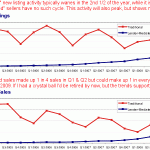
RealtyTrac uses a combination Notices of Default, Notice of Foreclosure (Sheriff) Sale, and REO (bank owned) inventory to create a total number of Foreclosure Filings.  I went back and looked at the last 17 months of their data and saw a very dramatic change in their reporting for Notices of Foreclosure Sale data.  Take a look for yourself in the chart below:

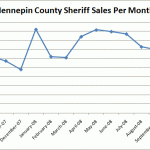
See the astonishing increase in notices from March 2009 and on? What happened in March that started a trend that has continued for the last 9 months?  Honestly, I’m not quite sure.  The numbers RealtyTrac is reporting are the notices of the future Sheriff Sale versus the actual sale itself.  I and others in the business have noticed that some lenders are postponing sheriff sales multiple times, which can account for some of the increase but we’re talking about an increase of 100% – 500%… far too much to be dismissed so easily.  For reference, take a look at HousingLink’s Q3 2009 Foreclosure Report and review the chart below of the number of sheriff sales:

In Q3 & Q4 2008, RealtyTrac counted sheriff sale notices that accounted for 40% of the sheriff sales that HousingLink reported.  In Q3 2009, RealtyTrac counted 167% of the number of sheriff sales reported by HousingLink.

The Minnesota Home Ownership Center tracks a different number – the number of pre-foreclosure notices.  These notices are sent out when foreclosure proceedings are starting and are often sent 2-5 months prior to the sheriff sale itself.

While there is no denying that foreclosure activity is high and that it is likely to remain high for some time to come, I find RealtyTrac’s data very suspect and consequently their analysis on foreclosure rates in Minnesota is suspect as well.  Does anyone have an answer?

Minneapolis & St. Paul Foreclosure Short Sale Report Updated

MAAR’s Foreclosure and Short Sale Report (FSS for short) has been updated for November 2009.  Since October we are now publishing this report MONTHLY and have broken out foreclosures, short sales and traditional sales separately.

There is a TON of information in here to see but some of the big items of note:

  • Foreclosure/REO new listings are down 42.4% from November 2008.
  • Foreclosure/REO inventory is down 63.4% from November 2008 – now at less than 2 months’ supply.
  • Foreclosure/REO median sales prices ROSE 2% year of year – the first year over year increase!
  • Traditional Seller median sales prices FELL 15.6% from November 2008 to November 2009.
  • Short Sale median sales prices FELL 15.6% from November 2008 to November 2009 as well.

There’s lots more to cover than I have time for right now but the reporting has become so detailed and clear that almost anyone can spot the dozen or so other notable items.

Read the latest report here.


Equal Housing Opportunity and REALTOR logo

TwinCitiesRealEstateBlog.com is not a Multiple Listing Service MLS, nor does it offer MLS access.
This website is a service of Aaron Dickinson of Edina Realty, a broker Participant of the Regional Multiple Listing Service of Minnesota, Inc.