How Much ‘Shadow Inventory’ Is There?

The National Association of REALTORS has put together a video discussing the amount and type of  ’Shadow Inventory’ nationally.  The biggest problem with such figures is that they are still based off of sampling & definitions of what is or is not counted in the definition.  Regardless of what the actual number is, the video discusses how banks are putting more focus on short sales than they have in the past – which I believe to be a much better option than letting these properties go through the entire foreclosure process.

Also of note is the reiteration that banks are not going to just dump huge amounts of new inventory on the market – they understand that this is not in their interest and to be honest, they can’t process this stuff fast enough to dump a huge number of new foreclosures on the market – the foreclosure process is a long one and each can take a little different timeline so by their very nature they are likely to come on in a staggerd fashion.

I still do not subscribe to the idea that there will be some huge “wave” of foreclosures coming, but rather that we will continue to see the high levels of activity that we have seen since 2008.

In A Short Sale, Who Represents The Lender?

Twin Cities February closed sales showed that bank owned foreclosures were 35% of the month’s closed units and short sales represented another 13% – making Lender-Mediated homes sales almost 50% of all residential home sales in the Minneapolis/St. Paul region.

On a bank-owned home the Seller is of course the bank and therefore the Listing Agent represents the bank.  On a short sale however, the Listing Agent represents the Seller, which in this case is the current homeowner.  So while the agent must treat all parties honestly, their loyalties and fiduciary duties are only to the Seller.

This situation leads to several issues:

Unfamiliarity with Lender’s Process
With the large number of lenders and servicers out there, a listing agent working on short sales may have had only a few experiences with the lender in the past (if any) and therefore may not be fully educated on the idiosyncrasies of how that lender processes short sales.  This can lead to delays in the short sale process from the lender requesting additional and/or revised documentation.

Submission of Offers
In many circumstances, the listing agent clearly states on the MLS listing that only one offer will be signed and submitted to the lender and any subsequent offers will be held by the seller as backups.  While this provides great encouragement for the first buyer to stick around through what can be a very lengthy response waiting period of 4 weeks to 6 months, it means that even if a subsequent offer submitted is for more money, that offer is very unlikely to ever be seen by the seller’s lender.

I’ve been hearing more about the occurrence of non arm’s length transactions, which are transactions where parties involved are related, do business together, or are otherwise connected and are colluding together.  In these cases there is often an abuse of the situation that is being conducted to the benefit of the buyer and/or seller without the the seller’s lender’s knowledge.

Pricing and Negotiating
When an agent lists a bank-owned or traditional seller listing, pricing and market time are carefully considered and discussed with the Seller.  In the case of a short sale where the seller is receiving little to know monetary compensation at closing, the seller and agent may be more motivated to procure an offer in the least amount of time possible and hence list it for sale below true market value.  Same thing when an offer comes in from a buyer – the seller and agent are likely to counter anything that affects the likelihood of a successful closing or if the offer is incomplete or incorrectly filled out, but they have little incentive to negotiate on price with fervor.

While the introduction of HAFA may mitigate some of these issues, it still does not change the fact that the lender has no advocate for their best interests involved at the transactional level.

Traditional Sellers Have Window of Opportunity

A while back we released the 2nd Quarter Foreclosure (REO) & Short Sales Report, which not only debuted another revision to the methodology that decreased the counts of foreclosures and short sales significantly, but also showed positive trends in this market segment.  Good signs included:

  • New Lender Mediated listing activity has remained steady over the last 5 quarters
  • Lender Mediated sales continue their 3-year trend – going up and up each quarter
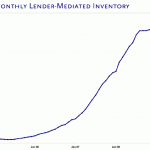
  • Lender Mediated inventory for sale has been dropping due to the capped new inventory and skyrocketing sales
  • Lender Mediated median sales prices are showing a potential bottoming.

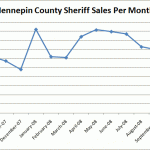
One thing that has helped stem the tide of new lender mediated listings is the substantial {decrease of Sheriff Sales over the same time last year}, which has lead to fewer new bank owned homes coming on the market.  Due to the 6 month redemption period after Sheriff Sale that most foreclosures include, there is likely to be far fewer new bank owned listings coming on the market until the end of 2009 and early 2010- though it appears likely that a new wave of foreclosures is likely to hit in 2010.

The other component of lender mediated listings, short sales, are a significant part of the listings we have for sale today (approximately 15%) but make up a miniscule number of the closed sales (5%) according to the analysis of June’s sales activity… the first month in which we could break out bank owned homes and short sales separately.   Reasons for this include the following:

  • Short sales are listed at a price that is not guaranteed to be sufficient to buy the property; the Seller needs to negotiate with their lender or lenders
  • This negotiation process can take 3 weeks to 3-4 months and often ends with a counter-offer of rejection from the Seller’s lender(s)
  • In my experiences with short sales, approximately 1 in 3 offers leads to a successful closing

Getting back to the title of this article, why do Traditional Sellers have a window of opportunity?

  • With new bank owned listings at reduced levels and less than a 2 months’ supply of inventory, many buyers will not find what they are looking for with such a relatively low number of these listings.
  • The first time home buyer $8000 tax credit expires on November 30, 2009 and most transactions take 3-5 weeks to close after an offer is made.
  • Buyers will have to have chosen and negotiated on a house by the end of October to have a reasonable assurance of closing prior to the expiration of the credit.
  • Banks do not have great concern over deadlines when dealing with REOs, so they are not likely to consider November 30th a “make or break” date even though the buyer will.
  • Buyers making offers on short sales risk missing the tax credit if the answer from the seller’s lender takes to long or isn’t acceptable.
  • In the coming weeks Buyers will find that the only option they have available to them has been the one who has been ready and waiting for this moment: the Traditional Seller.

If you are a Traditional Seller and your house is currently listed, keep it listed through Halloween if you can.  In past years the market quickly quiets after school starts but this year appears to be very different.  If you’ve been considering taking an additional price reduction, take it as soon as you can so you are priced correctly when the buyers interest swings your way this will likely be you last-best-hope for selling till March 2010.

Traditional, Bank Owned and Short Sales – A Comparison

Most of my buyers are NOT housing experts… they are “regular people” and are experts in whatever field they work in but not in real estate.  That’s just fine because that’s why people like me have jobs doing what we do!  One of the most frequent topics that comes up is the differences between traditional sellers, short sales and bank owned (aka foreclosure or REO) homes.  Below you will find a summary of many of the big differences, which is also available in a PDF one-page format if you’d like to print it.

Traditional Seller

What is it?

Most often Traditional Sellers still occupy the home. The Seller is the home owner and they can afford to sell the property at the price listed in the MLS without approval by a 3rd party. Moving by CHOICE.

Condition of

Property

Usually home is maintained appropriately and may only need minor repairs/cosmetic updates. Utilities are current-water & heat have been kept on.

Disclosures &

Warranties

Seller is required by law to disclose defects in the property. Sellers will be able to educate Buyers on work done to the home & any prior problems/issues; frequency & how issue was resolved. Small claims court or arbitration are legal options Buyers may use to pursue Seller if they feel an issue was not properly disclosed.

City

Inspections

(if required)

Seller will have any city required inspections completed per city code. Often Seller will repair major items found on the inspection prior to listing or will negotiate with the Buyer on responsibility of those repairs. Traditional Sellers are typically the most practical and flexible when it comes to inspection issues.

PA

Response

Timeline

Listing agents can typically get an offer to a Seller & have their response back to the Buyer within hours or a day at most.

Financing

Options

Due to condition, most homes will meet FHA, VA & Conventional appraisal and underwriting guidelines.

Closing

Sellers and Buyers attend closing together and sign all paperwork. Often a bonding moment over the transfer of home to new owners.

After

Closing

Some Sellers & Buyers exchange contact information in case there is a question about how something works in the home. If the Buyer feels there is a problem with the property, they contact their agent who will contact the Sellers agent to try to resolve issue.


Short Sale

What is it?

Seller may or may not occupy property. They are facing a financial hardship (the house may or may not be in foreclosure) and have the home listed for sale at a price less than they can afford to accept.  They are asking their lender(s) to agree to take less than the amount owed on the home as payment in full so they can sell the home.

Condition of

Property

Homes are often in a state of disrepair due to inability to pay for required maintenance/repairs. Homes are often vacant and show signs of distress, wear & tear or lack of care. There are of course short sale properties in “mint condition” but these are the exception.

Disclosures &

Warranties

Seller is required to disclose defects in the property, however may require the Buyer sign an “As-is” Addendum due to the fact they may have vacated the home months ago & are unsure of changes in condition. Disputes after closing may be harder to resolve as seller may have little to no financial assets to seek for damages.

City

Inspections

(if required)

Seller likely does not have funds available to pay for city inspection, so many aren’t done until AFTER a Buyer has had their Purchase Agreement signed by the Bank (which could be months after offer was submitted). Sellers typically require Buyers assume responsibility for those issues & escrow 1.5x the cost of the repair at closing if required by Buyer’s lender or city code.

Purchase

Agreement

Response

Timeline

Listing agent needs to track down Seller, have them sign Purchase Agreement and then get it submitted to Seller’s mortgage company. Can be 3 weeks to 3 months before Seller’s mortgage company responds.

Financing

Options

Current condition may make FHA and VA mortgages harder to get due to tougher condition guidelines but many will still qualify. Conventional normally not a problem.

Closing

Seller will often presign required short sale package from lender & send power of attorney to closing. Closing docs will need to be submitted to mortgage company & deficiency must be signed off on by mortgage company. Sometimes Seller does attend closing.

After

Closing

Sellers are gone-occasionally a delinquent utility bill will surface. Home may still have debris remaining and/or may not have all of the personal property as agreed upon & sometimes appliances go “missing”.


Foreclosed/Bank Owned

What is it?

Vacant home. The prior home owner lost the home through the foreclosure process or gave the keys back to the back in what’s called a “deed in lieu”. Seller is now the bank who filed the foreclosure action. The price listed on the MLS is a price the seller will accept, though it may require additional approvals.

Condition of

Property

Vacant properties-remaining personal property & garbage has been removed. Home is left in last known condition & has been winterized to prevent pipes from freezing/water damage & mold, though some foreclosures are damaged prior to the bank’s possession.

Disclosures &

Warranties

No disclosures/property history available. Buyers must sign “As-is” Addendum as part of Purchase Agreement releasing Seller/Bank from liability on non-disclosed issues. Seller/Bank would have no known prior knowledge of defects since they have not lived in the home-many Banks have not ever seen the property they are selling.

City

Inspections

(if required)

City inspections usually completed as required by city code, however, Buyer is required to assume & escrow for the repairs. Many cities require Buyer to escrow 1.5x the cost of the item at closing.

Purchase

Agreement

Response

Timeline

Listing agents can get offers submitted to banks (during business hours) and Buyer usually gets a response within

24-72 hours.

Financing

Options

Some are in good condition but the majority have some issues that make FHA & VA financing difficult- each property must be evaluated separately.

Closing

Seller/Bank will presign all docs and send them to title company for closing. They will require the final HUD-1 settlement statement to be sent to them 72 hours prior to closing for review-sometimes the Seller takes extra hours or days to sign and closing is delayed.

After

Closing

Home is de-winterized, home may or may not have all of the personal property/appliances as seen at the home prior to closing. Seller’s “As-Is” addendum covers Seller/bank in the event something goes missing prior to closing.


Equal Housing Opportunity and REALTOR logo

TwinCitiesRealEstateBlog.com is not a Multiple Listing Service MLS, nor does it offer MLS access.
This website is a service of Aaron Dickinson of Edina Realty, a broker Participant of the Regional Multiple Listing Service of Minnesota, Inc.