

Crystal Ball – Foreclosure Prices Have Bottomed in Twin Cities


For weeks now I’ve been getting the feeling that we’ve turned the corner on prices in foreclosures. Today I’m ready to go out on a limb and take the position that prices on bank owned inventory has bottomed and in fact is likely to bounce up some over the next few months. These are the reasons why I believe we’ve come to this moment:
Inventory is Falling
(image courtesy MAAR)
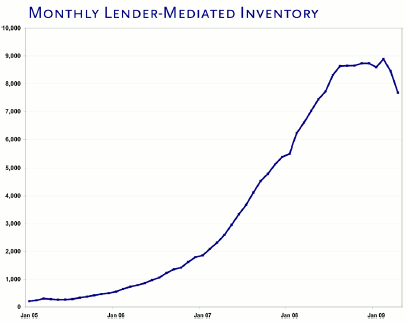
From February 1, 2009 to April 1, 2009 the inventory of lender mediated (short sale and bank owned) listings has fallen by 1200+ units… a drop of over 13% in just two months. Indications through the first half of April suggest this trend will continue and I’m predicting we’ll be down another 600-700 of these lender-mediated listings once we close out April’s books. While this data includes both bank owned AND short sales, I think the trend is most prevalent in the bank owned homes… see below.
New Listing Activity Appears to be Peaking
(image courtesy MAAR)
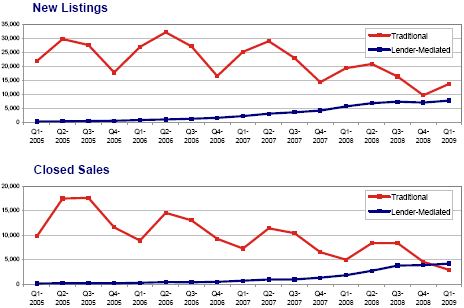
Q3 2008, Q4 2008 and Q1 2009 show a peaking of new lender mediated listings coming on the MLS… while no one can say with certainty what will come in the future the fact that this trend has so dramatically broken past trend is a great sign. �Yes the numbers of new listings coming on are still high but the demand is swallowing this new supply faster than it is coming on.
Multiple Offers are the Norm
As recently as January and February it was rare to see multiple offers on many foreclosures but since March 1 the multiple offer has become almost as common as the foreclosures themselves! Homes are being priced much better by the banks than they have been in the past and with the dramatic drop in interest rates since last year and the HUGE financial incentives for buyers we’re really seeing the fire sale I was discussing a few months ago come into play.
Hennepin & Dakota County Sheriff Sales Well off Peak
(image courtesy MAAR)
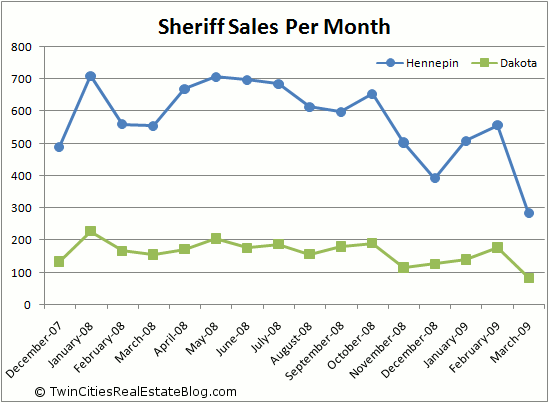
Everyone is talking about a “2nd wave” of foreclosures coming but we’re not seeing any signs of that yet at the local level. In fact, new Sheriff Sales have been substantially down from their highs for many months. While the temporary moratoriums of Fannie Mae and Freddie Mac between Thanksgiving and Valentine’s Day and many other lenders in early 2009 holding their foreclosures until the new housing initiatives came out in March have contributed to the lower numbers in recent months the trend down started before the lenders made those adjustments. In March 2009 Hennepin County reported 284 Sheriff Sales and only 169 through April 16, 2009, which means we’re on track for approximately 340 sales this month… 1/2 of our monthly peak back in July 2008! Any future surges in foreclosures should show up in the county data first and will take approximately 6-7 months to show up on the MLS as bank-owned homes.
Months of Supply has Dropped Dramatically
(image courtesy MAAR)
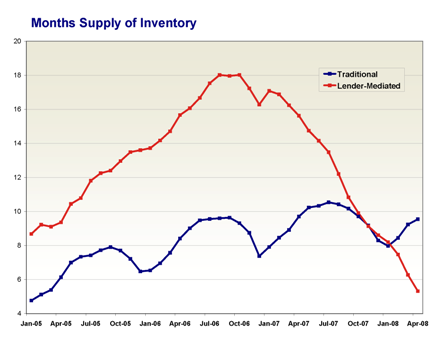
The huge increase in demand coupled with the decrease of supply has meant that in the last 12 months we’ve dropped from XX months’ supply to only XX months’ supply. If trends continue as they have, we should see a further drop for April’s figures and into May before potentially flattening out by July as typical seasonal buyer activity starts to wane.
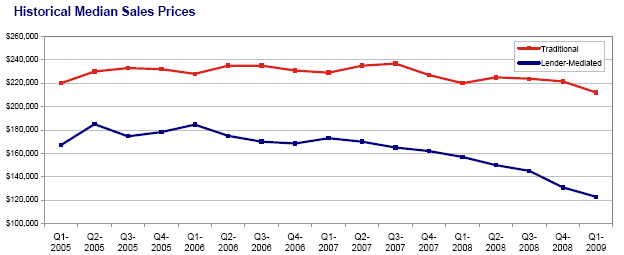
Lender Mediated Sales Prices Have Fallen Steeply
(image courtesy MAAR)
We’ve seen huge price drops on lender-mediated properties in the last 3 years and that price decrease has brought these homes down to a fundamental value that people clearly recognize and has thus brought many home buyers and investors back into the market after years on the sidelines.

Comments
Comment from Aaron Dickinson – Edina Realty
Time April 22, 2009 at 4:41 PM
As always I love the dialog! I don’t have Days on Market comparison but I do have Months Supply in a table format, which does give a good comparison of relative supply to demand. Days on market between the two was quite close till recently… I’ll see if MAAR can do that chart at some point.
Sellers are in many cases still overpriced in my opinion. Many are still stuck with an unrealistic vision of the value of their home in today’s market. The hard part is that if they can’t sell this year at the price they’re at today, how will they sell it next year when rates are likely to be 6%, or more? That’s an increase in payment of 20% or so… ouch!
Until Months of Supply gets back down to around 6 or so, Traditional Sellers will continue to face strong pricing pressures. I’m working on an article focusing specifically on these issues for sellers.
Comment from Dave
Time April 22, 2009 at 8:56 PM
If I understand you correctly, your call is that the prices on foreclosures have bottomed in this market. And, you state by your chart that bank owned supply is 5 months, I believe.
I have to agree with Ryan that more bank owned supply is coming.
As “traditional” prices are being suppressed by bank owned properties, more people will go underwater in terms of loan to value. If true, that would increase inventory. Refinancing may be more difficult regardless of interest rates if equity continues to erode.
Additionally, more job losses could increase the bank owned supply.
In time, either the new owners of the foreclosed properties see appreciation or the “traditional” values head down towards the forclosed properties, or some of both, which is more likely.
A reknown bank analyst has publically stated credit card limits will be reduced in half to $2.5 trillion, calling that a pay cut for the 90% of Americans using revolving lines of credit. She stated possibly all credit card holders will experience reduced credit card limits. That would cut consumer demand further, creating more job losses.
The stimulus measures, including first time home buyer credits, are temporary. I see on this website that you state FHA, 3% downpayment mortgages are being used extensively. So, in effect, with the tax credit, buyers are being paid to move their rent payment to a deductible mortgage payment. A no risk proposition. A point of bottom. At the same time the Government is buying down mortgage rates. The FED now owns almost $5 trillion of all federal debt. And, in effect, housing is still being sold with less than zero down. The difference this time is the Government is the instigator through FHA and interest rate buy downs and not the private mortgage investors. And, of course, now the prices are much lower.
One question is: “Can the FED buy unlimited debt?” Some say yes.
But then, when rates do rise, will that end most real estate transactions? And then, is that the collapse of the “traditional” home sales market? Contract for deed doesn’t work too well on homes with existing mortgages.
Are these bank owned properties sucking the last available buyers out of the market for quite some time?
Some are proposing the economy is in a long term deflationary period where Treasuries will out pace the stock markets. If this becomes truth, housing prices could continue to sink, while activity still remains solid around depressed prices and low interest rates. Would this type of situation be a boon for first time home buyers for quite some time?
My point overall is that while your prediction may turn out to be correct, the result may be an extended, long term, damaging destruction of “traditional” home prices. This would be a disaster for the return of the consumer economy for potentially an extended period of time.
Benefits such as home buyer tax credits for all buyers may be beneficial. But then we are further using taxpayers to support the markets.
Anyway, with the current tax credits and financing structure at the low price end, a bottom may be in for bank owned housing, but the “traditional” market may be the tremendous loser.
Comment from Aaron Dickinson – Edina Realty
Time April 22, 2009 at 9:20 PM
Dave,
You make excellent comments. My feeling is that Traditional Sellers in many cases have further to fall on their prices because they are still high given historical levels. As far as future foreclosures my concern lies more with Option Payment Arms versus unemployment since unemployment benefits last quite some time, there are often multiple incomes in the household, and there’s still 50 million homes out there with no mortgage. When 30%+ of subprime mortgages are defaulting that’s pretty dramatic versus an unemployment rate that’s gone up by around 5% in the last year.
I’m not sure how much Traditional Sellers need to come down yet… the two recent Traditional Seller sales I’ve done had the sellers drop their prices 10%-15% further to get my clients to buy but then I’ve seen several on the MLS sell recently for full price as well… with such variety in the housing stock any summarization does simplify things at the expense of reliability.
You’re the second consumer to bring the same points to me today with this post and I will be doing some more blogging on this topic as I feel the dialog is very good. I specifically left Traditional Seller pricing out of this post because I know it is so much more of a complex issue and a story all on its own.
Comment from Dave
Time April 22, 2009 at 9:55 PM
Thanks, Aaron. My point would be that history doesn’t mean much this time. The U6 unemployment rate is 15.6% and is accelerating per my information. U6 is where one ends up in the stats when the unemployment runs out, along with the current unemployment benefit folks. These are the folks potentially relying more heavily on credit cards. Some predict this U6 rate will exceed 20%, which is unfortunately then nearing the Great Depression era.
Option payment arms is another good point of wealth destruction. An additional fact that you wisely are considering.
The people without mortgages aren’t spenders. Not so good for a consumer based economy. They won’t as likely sell their houses. Good for supply. Still, that’s 1/3rd of the home owners. Leaves a lot of others not in that category. These folks may also freak when their credit card limits are reduced and spend even less.
Many qualified their mortgage and second mortgage on those two incomes. The loss of one income is serious for many households. It’s all about jobs. The result of less jobs is more defaulted mortgages at this stage. The housing debacle has moved from a cause to an effect. We now have fundamental economic structure issues that are the cause.
I enjoy your approach of investigating and not burying yourself in the sand. None of us can really know the future, but trying can be useful.
Comment from Oakland Real Estate
Time June 6, 2009 at 12:19 PM
OK, I’m sure ready for the bottom. Lets get the real estate market moving in a better direction.
Pingback from Twin Cities Real Estate Blog » Jim Cramer: Housing Market Has Bottomed
Time June 17, 2009 at 6:40 AM
[...] on a local level I’m not ready to call a housing market bottom. I do believe however that foreclosures have price-bottomed in our market. Unfortunately I also believe that the typical Traditional Seller has further to fall. Related [...]
Pingback from Twin Cities Real Estate Blog » Traditional Sellers Have Window of Opportunity
Time September 23, 2009 at 8:41 PM
[...] Lender Mediated median sales prices are showing a potential bottoming. [...]
Pingback from Twin Cities Real Estate Blog » Twin Cities Multiple Offers Multiplying
Time December 29, 2009 at 3:44 PM
[...] While the multiple offer phenomenon is largely focused on the foreclosure market, the fact that multiple offers exist at all in today’s market is a great sign. It says that the market has found price levels and financial conditions favorable enough to draw many bidders for each home. This will help put a floor in house prices in this category and lead to dramatic inventory reductions as these…. [...]
Pingback from Twin Cities Real Estate Blog » 8 Predictions for 2010 Housing Market
Time January 7, 2010 at 8:19 AM
[...] sales prices will remain flat or tick up slightly – foreclosure prices are at their bottom but short sales and traditional sellers will likely drop a little further but higher-priced homes [...]


Comment from ryan l
Time April 22, 2009 at 3:08 PM
Mr. Pessimism here….How does the average time on market compare between lender mediated vs traditional?
Between your chart above showing a decline in closed sales of traditional homes and my personal experience of watching more than a handful of homes in my area on the market for over 1 year it seems to me like traditional sellers may have their head in the sand when it comes to pricing.
Count me in with the naysayers looking for another round of foreclosures once the Credit Card Companies march to congress for a bailout and are forced to reign in their lines.