Q&A – How to Spot a Recovering Housing Market

I hear buyers, sellers, lenders, real estate agents and the community as a whole rhetorically ask when we’ll see the housing market recover.  Unfortunately putting a timeline on a housing recovery is pretty unrealistic as there are simply too many variables to account for.  But all is not lost!  While I cannot predict when the housing market will recover, I can give you trends to watch for that will signal a turnaround and their current indicators.

Falling Inventory
Supply & Demand 101: if demand has fallen sharply, supply must also fall sharply to keep prices in line.  Supply in the Twin Cities is still near record highs, so it must come down significantly.  The trend is certainly going the right direction (inventory is falling +/- 200 listings per week vs. last year) but this improvement is still minor and early at this point.
Trend: Positive

Falling New Listings
So far this year we’ve seen 9.5% fewer new listings come on the market versus the same time period last year, which has www.ered total active listings this year.
Trend: Positive

Increasing Sales
The supply problem can also be resolved by more buyers coming in to the market.  As of May 1, we’re still 12.6% behind last year in the number of Pending Sales year to date, so this indicator still needs improvement.
Trend: Negative

Falling Days on Market
Ultimately we will see the market times of listings fall, but in April it still took on average 154 days to sell a home in the Twin Cities… an increase of 16.7%.
Trend: Negative

Flat Median Sales Price
When we see the sales prices year-over-year flatten, it will show we’ve reached a price stability level and encourage more buyers back into the market.  In April our median sales price was down 7.9% from a year ago, so we’re not there yet.
Trend: Negative

Fewer Foreclosure and Short Sale Listings
While it is clear that foreclosures and short sales are different animals from Traditional Sellers, they do have a strong influence on the housing market direction and we need to see them reduce in both number and market share before we can see a strong turnaround.  These listings are still coming on strong and while their number and market share hasn’t changed much in recent months, they still account for slightly more than 1 in 4 sales in the Twin Cities.
Trend: Negative

Low Mortgage Rates
Mortgage rates still continue to bounce between approximately 5.75% – 6.25% on a 30yr fixed rate, which is still phenomenally low.  As long as these rates stay below 7%, buyers will have strong buying power in this market. If rates climb above 7%, buyers will pull back hard.
Trend: Positive

More Flexible Financing Options
I’m not talking about the return of subprime, I’m only talking about more options for borrowers with little/no down payment.  Fannie Mae reversed their position on “declining markets,” FHA is looking at lower down payment requirements, more risk-based pricing options coming back… while it isn’t going to be the world of free money like it was before, financing options seem to be improving.
Trend: Positive

Increased Market Optimism
Markets are often self-fulfilling prophecies… while the general public (and the media) are still down on the real estate market, the market will continue to perform badly.  This is something that only time and continued good news can cure.
Trend: Negative

The Return of the Professional Investor
I’m seeing and hearing a lot more about investors lately… more so than I have for at least a year or two. The Professional Investor will go out and cherry-pick the best inventory even if a market bottom hasn’t been called… they know a good deal when they see one.
Trend: Positive

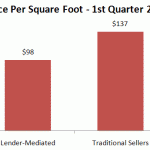
Price Per Square Foot – Lender-Mediated vs Traditional Sellers

As a follow-up to the report I co-authored with Jeff Allen from MAAR, below is a comparison of price per finished square foot between lender-mediated sales and traditional sales.

As can be seen by the chart above, there is a substantial price discount on a cost per square foot basis when you look at lender mediated sales. My reasoning for why this is happening is as follows:

Short Sales

  • Short sale transactions often take several months to come together, thereby reducing the number of buyers willing to deal with the unsure and lengthy nature of these transactions, which reduces demand and price accordingly.
  • A large number of sellers in a short sale position have not had the money to properly update/maintain the property, so there is an issue of diminished condition as well.
  • Sometimes listing prices are set artificially low to encourage offers, and even in multiple-offer situations it is rare to see a home sell for much above asking price.

Bank Owned Homes

  • Often the condition of these homes is substantially poorer due to their neglect and/or abuse.
  • Frozen pipes & water damage are frequently found, causing substantial loss of value of the property.
  • The complete “as-is” nature and some of the arduous terms/conditions banks put on the property make it less appealing to purchasers, and worth less accordingly.
  • Many of these homes are in poor showing condition… electricity/heat/water off, broken light bulbs, stained carpets, dirty floors/walls, etc.
  • These homes compete for a much more limited number of buyers willing to deal with the bank’s terms and the condition of the homes.

From the transactions I’ve participated in, I would most definitely say that the typical short sale receives a higher price per square foot than the bank owned homes, but because of how we have to query for these properties, there is no way to split this data out into “short sale” and “bank owned” categories. So short sales have a higher price per square foot (but still well below “traditional sellers”) and bank owned should have a lower price per square foot than the “lender-mediated” category suggests.

Equal Housing Opportunity and REALTOR logo

TwinCitiesRealEstateBlog.com is not a Multiple Listing Service MLS, nor does it offer MLS access.
This website is a service of Aaron Dickinson of Edina Realty, a broker Participant of the Regional Multiple Listing Service of Minnesota, Inc.