Foreclosures and Short Sales Don’t Matter to House Prices

While foreclosures and short sales continue to be around 40% of our sales, when looking at housing prices I believe they should be completely ignored.

When looking at all Twin Cities housing sales, here is how the Median Sales Price stacks up:

median sales price - all properties - twin cities real estate


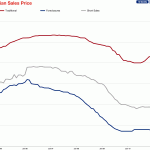
When we split it out to look at Foreclosures, Short Sales and Traditional Sales, we see that Traditional Seller prices have not fallen nearly as much as the composite number suggests:

median sales prices for foreclosures & short sales - twin cities homes


Why we should ignore foreclosure and short sale sales data

If we go back to 2005 and before, the Twin Cities had almost no foreclosures or short sales… something between 1%-2%.  The Traditional Seller market was the market just 6 years ago and once we clear the current housing downturn they will be the market again.

Still, today when Foreclosures and Short Sales account for 2 of every 5 sales, why should we ignore them?  After giving this a lot of thought the answer seems almost obvious now but certainly wasn’t before:  Foreclosures and Short Sales already affect Traditional Sales’ prices.

Today every seller is competing against all other homes on the market, including bank owned and short sale homes.  Each Traditional Seller that successfully sells their home had to go through the pricing and competition gauntlet to secure a buyer at the price and terms of the sale.  While some Traditional Sellers have stronger motivation to sell than others, they don’t have nearly the motivation to sell as a bank.  Whether a foreclosure or a short sale, the bank ultimately determines the sales price and they’re far more motivated to unload properties at whatever price they can get.  This is similar to a wholesale auction versus a retail sale.  One must also take into account that most foreclosures and short sales typically need money for repairs as well, which further decreases their value at time of sale.

So since Traditional Sales already sell at prices that take into account the competition from Foreclosures and Short Sales, by including them in sales price averages we are effectively double-counting the impact from these distressed properties.  Consequently the truest measure of where our housing market was, is and will be is found by looking at the prices that non-distressed sellers are getting in this market.

Stupidly Slow Short Sales That Seldom Sell

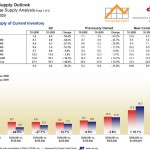
Here we are, years into the housing crisis, and it seems like while banks have become pretty good at selling foreclosures they are still horrible at closing short sales.  On average, short sales a have substantially lower chance of closing than traditional or bank owned listings, which means a huge number of short sales fail and go back to the bank as foreclosures.  At the end of the day, short sales sell for far more money than they do as an equivalent foreclosure so each failed short sale means thousands or tens of thousands of dollars more value lost:


While both Traditional listings and Lender Owned listings have had a decrease in days on market, Short Sales continue to see increases in days on market, which means that the response time from lenders is not improving but likely worsening!!!


If we can get more short sales to close then we will see fewer foreclosures in the future and less pressure on housing prices across the entire market. A successful short sale cuts a good 6-12 months from the housing crisis but only if the lenders, servicers and mortgage insurance companies work together to accomplish this task together.

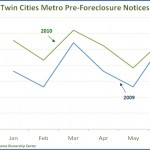
2010 Twin Cities Pre-Foreclosure Notices up 20% vs 2009

The Minnesota Home Ownership Center has been tracking pre-foreclosure notices received by foreclosure counseling agencies throughout Minnesota and just posted some updated charts that show 2010 pre-foreclosure notices are consistently higher than the same time frame in 2009.  Through June 2010, notices are up a considerable 20%:

Twin Cities Pre-Foreclosure Notices

I don’t find these numbers very surprising: the lackluster economy isn’t providing the new jobs necessary to reduce unemployment and those who are unemployed can only afford to make house payments for so long.  In a few weeks we should see HousingLink’s updated foreclosure report that shows how many properties went through sheriff sale.  While it is clear those numbers will be higher than 2009′s, I am interested in seeing how they compare to 2008, which was Minnesota’s highest foreclosure activity year thus far.  Given recent trends I wouldn’t be surprised if we meet or even rise a little higher than 2008′s numbers.

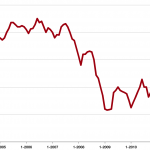
Twin Cities Region - New MLS Listings – 12 Month Rolling Average:

Any uptick in foreclosure activity is unlikely to have immediate impact in the home sale market because of the lengthy Minnesota foreclosure process and the time it takes banks to prepare those properties for resale.  So we are likely to see an increase in new foreclosure (REO) listings in 2011 to account for this.

The other trend to watch for though is the increase in short sales that are successfully closing.  June 2010 saw a 40% increase in short sale closings from the same month in 2009 and represented 11% of all sales in the Twin Cities in June, up from just 7% a year ago.  As short sales close in higher numbers we may see fewer homes that receive pre-foreclosure notices go through sheriff sale and thus eventually less bank owned listings on the MLS.

1300 Sellers in Twin Cities Waiting for Lender Short Sale Approvals

Based on my personal analysis of our local MLS database, approximately 1300 Twin Cities sellers and at least as many buyers may be waiting for their offer on a short sale property to be reviewed and accepted/rejected/countered by the seller’s lender(s).  The number of buyers waiting for answers may be substantially higher than the number of sellers because many short sale listings have multiple offers on them.  Based on current sales activity, these 1300 in-limbo properties are equivalent to two weeks of pending sales.


Twin Cities Short Sales: By the Numbers

MLS-Listed For Sale Short Sale Homes:
4388 homes

Available for showing, but under contract and subject to 3rd party approval/other:
1046 properties, $174,000,000+ in MLS list prices

Temporarily Not Available for Showing (most under contract waiting for lender approval):
406 properties, $73,000,000+ in MLS list prices

If we round these numbers down to be conservative, we’re talking about 1300 sales worth $200+ MILLION worth of short sale properties waiting for banks to review offers.


Thinking Bigger:
(and in very round numbers)

  • Approximately 3.5 million people live in the greater Twin Cities region, which is about 1.1% of the total U.S. population.
  • The Twin Cities runs pretty average for the country in many respects, including mortgage delinquencies – likely a good indicator of short sales activity – so let’s just call us “average” for this exercise.
  • Take 1300 sales worth $200M in limbo here and extend it to the rest of the country gets you:
  • $18 BILLION in real estate short sales could be awaiting lender review
  • 117,000 home sales could be in limbo due to the short sale review process

Of course this is all a big supposition but I believe these to be reasonable numbers.  What do you think?

Equal Housing Opportunity and REALTOR logo

TwinCitiesRealEstateBlog.com is not a Multiple Listing Service MLS, nor does it offer MLS access.
This website is a service of Aaron Dickinson of Edina Realty, a broker Participant of the Regional Multiple Listing Service of Minnesota, Inc.