Q4 Lender Mediated Report & City Level Data Released

Today I am pleased to announce the release of the Foreclosures and Short Sales in the Twin Cities Housing Market: Q4 2008 Update.  This is the 4th installment of quarterly reporting of lender mediated sales and their impact in the Greater Minneapolis/St. Paul area, which I co-author with the musically, intellectually, politically and statistically talented Jeff Allen.  2008 reports from quarters 1, 2 and 3 are also available.

Here’s how to know if buying a foreclosure or short sale is right for you.

This quarter’s report continues to show the same trends we’ve seen all of 2008, mainly an increase in the market share of lender mediated MLS listings both for sale and those that sold in the quarter.  Traditional sellers are very seasonal and so while the fact that 46% of sales and 42% of new listings in Q4 were lender mediated is very notable, it is somewhat inflated by the seasonality.

While some trends have certainly continued from previous quarters, we have seen a new trend develop as well: the Q2-Q3-Q4 period showed a relative peak of new lender mediated listings coming on, and Q4 showed our first drop in both lender mediated new listings inventory for sale at quarter-end.  Prior to Q2 2008 we saw dramatically more new lender mediated listings each quarter since 2006, while the Q2-Q4 period demonstrated a stop to that growth, at least for now.  There’s no way to know whether this near-term peak will turn out to be the long-term peak of this market activity or simply a stepping block to higher volume in 2009 but the fact that this trend is solid for 3 straight quarters is certainly an optimistic indicator.Q4 Lender Mediated Report - New Listings

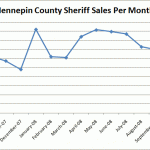
Hennepin County, who publishes their sheriff sales online for a rolling 12 month period, reported 550-700 sheriff sales each month for all 2008, with a significant trend down since July 2008.  November and December’s relatively low number of foreclosures may be at least partly attributable to Fannie Mae and Freddie Mac’s decision not to take foreclosure actions from Thanksgiving through the end of January (it was extended).  While Hennepin County is only one of 13 counties in the RMLS’s definition of the Twin Cities, it is by far the largest in terms of foreclosures and is a good (but not complete) indicator of what is going on in our market on the foreclosure side of things.  Keep in mind that the Lender Mediated report that Jeff Allen I produce includes foreclosures AND short sales while this data is only sheriff sales, which is a middle-step in the foreclosure process.  Most homes take 6-8 months after the sheriff sale to get listing on the MLS.
Hennepin County Sheriff Sales through December 2008

But Wait!  There’s Much More!

I’m glad you kept reading… this is where it gets really good.  For the first time in the Twin Cities, and I believe the first time anywhere in the country, we are able to release city/area level lender mediated sales information.  While the metro-wide reports are very helpful, they do not adequately explain what is happening in individual communities throughout the area.  Some communities are barely impacted by these listings, while other communities find that well over 50% of their recent sales and current inventory for sale lies in foreclosures and short sales.  It also demonstrates using actual market sales information that the higher the proportion of lender mediated sales you have in an area, the more “pain” the traditional sellers in that community suffer as well, in terms of more significant year-over-year median sales price decreases.

As every expert in this field has said, this housing market is very localized and these new reports help give a better glimpse into how true that statement really is.  While this information is very helpful, it can sometimes be misleading as well.  We are working with smaller sample sizes when we get down to the local level and in many communities there simply was not enough data to accurately report what is happening, so we didn’t publish data in those communities.  In the communities we did publish, there is the occasional “huh?” moment where the data reported simply doesn’t match up with the daily experiences in the market.  This could be because of the low sample size, which allows individual listings to have a major impact on the results, or it could be because what is selling today is different than before… i.e. some communities have very few Traditional Seller townhouses and condos selling but many single family houses selling so the Median Sales Price actually is higher this year over last year.  It isn’t that prices increased, but that the “typical” house selling this year is at a higher price point.  Unfortunately there wasn’t a reasonable way for us to take those kind of events into account and so we leave that interpretation to you.  Take a look at price per square foot as another good indicator of value changes… while this too can be skewed in some cases, it seems to be reporting numbers that FEEL more accurate to me in terms of change year over year than the Median Sales Price sometimes suggests.

Financing Costs for Twin Cities Homes – A Different View

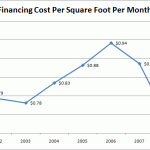
I love data… be it hard numbers, graphs, charts, tables, interpretation, etc.  I’ve come up with another concept of tracking overall affordability: combining cost per finished square foot with mortgage rates to give an overall cost of financing each square foot of house over the last few years (I only had data back to 2002):

Twin Cities Housing Finance Costs Per Square Foot - 2008

This chart is using approximate mortgage costs and an estimated cost per square foot for 2008 so this isn’t “scientific quality” but the trend is very clear and I think it’s close.  What’s stark about this picture is that while most of us would agree that 2005 was the “peak” of the market, median sales price actually rose $1,100 in 2006 over 2005 and mortgage rates ticked up as well.  This lead to 2006 being the peak of homeownership un-affordability.  With the dramatic drop in house prices as well as interest rates in the 2nd half of 2008 we’ve seen financing costs for homes drop accordingly to levels not seen in many years.  This cost excludes taxes, insurance, utilities, maintenance costs and mortgage insurance, if any.

I think this is another good indicator of the improvement in affordability and shows that we’re getting back closer to more normal historic levels of affordability.  What do you think about it?

Twin Cities Housing Affordability Hits Record High

Just released from MAAR:

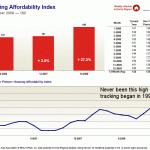
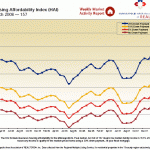
The Housing Affordability Index (HAI)�shot up 19 points to 180 thanks to the recent healthy declines in mortgage interest rates and a continued softening in home prices; the HAI has not been this attractive since we began tracking data in 1990.

What This Means to You

The dramatic fall in interest rates in recent weeks coupled with the substantial sales price reductions (mostly found in lender-mediated sales, which are foreclosures and short sales) has lead to an affordability index that we haven’t seen this high since the Minneapolis Area Association of REALTORS began tracking the figure 18 years ago!

This by no way means that every community and/or home has hit record affordability since some communities are extremely price stable in this housing correction but it is another indicator that points to a market that is quickly correcting to the strongest fundamental in the business: affordability.

NO ONE can tell you when we’ve hit a “bottom” in a market until the market starts to come back up.  I personally bought a new home in August and though the rates are about .5% better today, I am still extremely happy with my purchase and my timing… it was the right time for me.  Is it the right time for you?

Twin Cities Real Estate Sales Climbing

While the median sales price of homes in the Twin Cities continues to fall, there is some great news to be had as well.  No, this market downturn/correction/bubble burst/armageddeon/etc. isn’t over yet but there are some fundamentals that need to change before the market can turn around and several have or are close to changing.

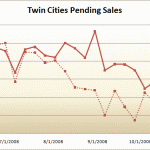
Twin Cities Pending Sales

Pending Sales took a nice turn above 2007 sales volume in August and have stayed above the year-prior figures even with the loss of 0% down financing on October 1 and the recently worsening economy.  As long as demand stays at or above year-prior levels it shows a fundamental sales level.

Twin Cities Active Listings

Inventory is also down approximately 9% from the same time last year, which is also a great sign that competition is decreasing between listings for a finite number of buyers, though pricing pressure still remains at these levels.

Housing affordability has also hit a 5 year high to 161 this month, thanks mostly to the median sales price reductions in recent months.  The Housing Affordability Index from 1997-2003 was in the mid 150′s to low 160′s before falling to a stunningly low level of 131 in 2006.  When buyers purchase more home than they can reasonbly afford we get the spikes in price we saw in 2002-2005 and inevitably see the fall of 2006-today.

This is not a post saying “the market has hit a bottom” but rather a post that tells you that while we are still in a difficult time, the fundamentals are beginning to lay the groundwork for an improving market as we move forward.  When the market hits “bottom” I believe is now more in the hands of the economy than the in the fundamentals I’ve just presented to you.

(data and graphs courtesy the Minneapolis Area Association of REALTORS)


Equal Housing Opportunity and REALTOR logo

TwinCitiesRealEstateBlog.com is not a Multiple Listing Service MLS, nor does it offer MLS access.
This website is a service of Aaron Dickinson of Edina Realty, a broker Participant of the Regional Multiple Listing Service of Minnesota, Inc.