2010 Twin Cities House Prices – Fall Forecast

Twin Cities Median Sales Price – All Properties

Median Sales Price- Twin Cities - All Properties

(image courtesy Minneapolis Area Association of REALTORS)

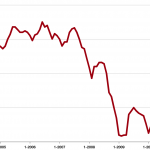
What does the fall and winter 2010 hold for Twin Cities home prices? If the last couple years are any benchmark, we should see median sales prices drop substantially… most likely back to the $155,000-$160,000 range that we have seen the last two years.  The fact that buyer activity has slackened since the expiration of the tax credits and our very seasonal market make this a pretty safe bet to make.

It is important to keep in mind that Median Sales Price can be useful but also deceptive – it doesn’t take into account the type, size, condition or location of the properties that are selling – it just looks at what has sold in the month and picks the price that is in the middle of all those sales prices.  A lot of what sells in the cold months are houses that must sell for reasons like relocation, foreclosure, estates, etc.  Many sellers are “fair weather sellers” that aren’t desperate to sell and therefore take their house off the market in the colder months or simply do not aggressively drop their price to sell.

In fact, when separating Median Sales Price out by traditional sellers, foreclosures (bank owned), and short sales we find that there really isn’t nearly as much variability as what the composite numbers show:

Median Sales Price by Type of Sale


(image courtesy Minneapolis Area Association of REALTORS)

Will Median Sales Price drop this winter? Yes.  Will actual home values drop this winter?  If history and seasonality hold true, yes… but not as much as what some of the market statistics will make it look.

Profit & Loss: Twin Cities Real Estate Market


(graphic modified from Minneapolis Area Association of REALTORS report)

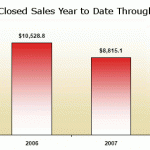
Using a little cut-and-paste magic, I wanted to take a look at the impact of the housing market’s shift over the last 4 years.  Comparing total sales volume (in Dollars) in 2008 vs. 2005 shows that we’re down 40% in the 3 years since the market’s peak.  Since most real estate agents & brokers earn their incomes from commissions based on the sales price of the home, you can see how incomes for the agents and their brokers are down dramatically.  Just like any other business, changing times require a changing business models and practices.  We’ve seen many real estate brokers close their doors, merge with other companies, or downsize this year.  The biggest market players, CB Burnet and Edina Realty, which combined produce over 1/3rd of the sales each year, have both closed offices and reduced headcount to accomodate the new market realities.  This is a necessary component of the right-sizing required to remain profitable.

Agents too have been in retrench mode.  I’ve seen many leave the business or place their license “on ice” so that they stop incurring the many different costs associated with being an agent.  I have also bumped into several agents as they now work a 2nd job trying to make up for lost revenues.  This was a market ripe with excess and a downturn was inevitable so while these changes are painful, they are part of the natural balance of things and will leave us with a leaner, stronger base to build from when the market recovers.

As the law of averages always goes, there are some agents doing far worse than average and some doing far better than average.  I feel lucky to count myself among the latter group but it has come at the cost of extra time and money required to keep activity and sales high.  As a whole my company and office are doing above average as well, which I find is a testament to the agents, management, and environment we’re in every day.  In fact, our parent company, Home Services of America, has been given a $250 million war chest by our owner, Warren Buffet’s Berkshire Hathaway, to use to go out and buy real estate brokerages that are fundamentally sound but challenged by today’s market.

In the broad economic downturn that is hitting our country, it seems as if most people are feeling some of its effects and I’d argue that the real estate agents and brokers are getting hit harder than most.  In the past people argued that real estate agents/brokers made too much money… I think those same people would have a harder time arguing that point today.

Adversity can bring out both the best and worst in people and challenges like this bring forth opportunities for improvement in our tradecraft.  While I’m not happy about the struggles that have befallen our market, I look at this as a chance for all of us to reset our expectations and actions and prepare us for a new beginning.  I’m a firm believer that a positive attitude and making smart decisions leads to being “lucky” and consequently I’m encouraging all of my friends in the business to not lose sight of the opportunities available if they simply continue to think positive and act smartly.

Foreclosures and Short Sales Skewing Twin Cities MLS Statistics

In the first quarter of 2007, sold homes reported by the MLS were 90% “Traditional Sellers” and 10% “Bank Mediated Sellers” (bank owned foreclosures and/or short sales).

In the first quarter of 2008, these “bank mediated” listings comprised more than 27% of the sales. The Median Sales Price of homes sold by Traditional Sellers in Q1 2008 was $220,000, down only 3.9% in the last 12 months, while the Median Sales Price for the bank mediated listings was only $155,000, down a substantial 10.4% in the last 12 months. With the help of a little statistics background, it becomes clear to see why the Twin Cities Median Sales Price fell so far… the substantial increase of foreclosures and short sales selling through completely changed the product mix and ultimately the median price point.

If you refer to the report I just co-authored on Foreclosures & Short Sales on the MLS in the Twin Cities, you’ll see that if you exclude the “bank mediated” listings from the statistics, Median Sales Price is only down 3.9% over last year vs. the current MAAR-quoted composite Media Sales Price decline of 9.7%.

What does this all mean?  Traditional Sellers are getting far closer to what they would have received last year than the bank mediated properties, and since Traditional Sellers still make up nearly 3/4ths of the market, that means this market hasn’t fallen nearly as far as some think (and as some hope).

Equal Housing Opportunity and REALTOR logo

TwinCitiesRealEstateBlog.com is not a Multiple Listing Service MLS, nor does it offer MLS access.
This website is a service of Aaron Dickinson of Edina Realty, a broker Participant of the Regional Multiple Listing Service of Minnesota, Inc.